Notes on The Rise and Fall of the Third Reich
I listened to an audio version of the book which lasts slightly over 57 hours, and I was surprised how captivating it was. Here is a handful of observations from the book.
Try to remember that all people are complex creatures
I noticed that when it comes to famous or historical people, such as politicians or entrepreneurs, I often have quite flat image of them in my mind. This image is formed from article headlines, facts from their lives or quotes. However, this image neglects the full range of human life complexities, which I am very aware of for people closer to me.
This book helped me to expand the image of Adolf Hitler. I am not sure what my mental image of Hitler was before reading the book. Since he was responsible for so much suffering, he became an almost human-less symbol of pure evil.
This book helped me to view him just as an actual human. He once was a child, struggling against his father's will to become a civil servant since he was 11. He was capable of love: towards his mother, whose death at Adolf's age of 18 struck him deeply, or towards his niece, whom he perhaps intended to marry. However, she committed a suicide after a quarrel between her and Hitler in 1931:
“Hitler himself was struck down by grief. Gregor Strasser later recounted that he had had to remain for the following two days and nights at Hitler’s side to prevent him from taking his own life. A week after Geli’s burial in Vienna, Hitler obtained special permission from the Austrian government to go there; he spent an evening weeping at the grave. For months he was inconsolable.” (p. 116)
This and a multitude of other influences culminated in him having such a twisted worldview, which brought so much havoc upon the whole world. But he was just a person nevertheless.
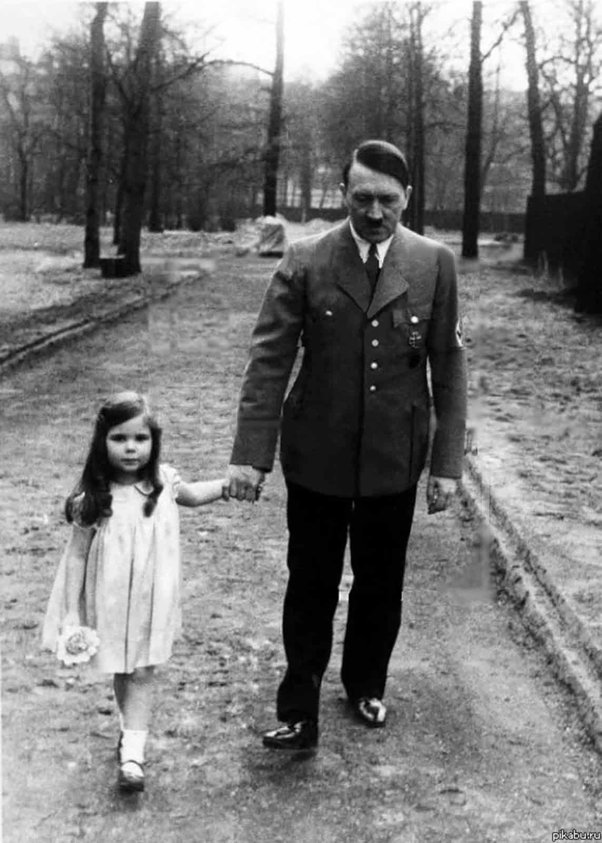
Hitler walking with Helda Goebbels, 1936 (source).
Try to think about past events without knowledge of the actual outcome
Historical events tend to seem inevitable. For me, Second World War was always something that happened, and it's hard to imagine that it wouldn't. The period between 1939-1945 is forever marked as years of the war -- how could it be any different?
This book helped me to disentangle the knowledge of what actually happened from how the situation looked at the time. For example, listening to a rocky start of Hitler's political career, it was easier to see how it could go nowhere. Similarly, during the height of Nazi successes in the war, I got a more vivid picture of how plausible it was that they could in fact win the war in the West.
”The final German victory over England is now only a question of A time,”General Jodl, Chief of Operations at OKW, wrote on June 3C, 1940. ”Enemy offensive operations on a large scale are no longer possible.” (p. 681)
Try to recognize and stand up to evil
I admired the characters in this story who could either stand up to the Nazi regime. This did not have to be in some grand or important way, like planning to kill the dictator (allegedly, there were 42 attempts to kill Hitler), but in less significant situations as well.
One example that struck me was that of Sophie Scholl and her brother Hans. In 1943, when Sophie was 21 years old and Hans 25, they distributed anti-Nazi leaflets at the Univesity of Munich, for which they were executed.
Sophie Scholl was handled so roughly during her interrogation by the Gestapo that she appeared in court with a broken leg. But her spirit was undimmed. To Freisler’s savage browbeating she answered calmly, ”You know as well as we do that the war is lost. Why are you so cowardly that you won’t admit it?” She hobbled on her crutches to the scaffold and died with sublime courage, as did her brother. (p. 919)
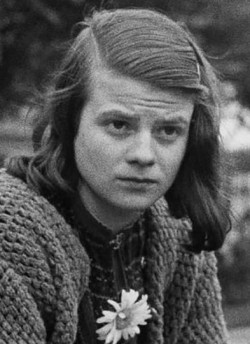
Sophie Scholl (source).
I realized that standing up to evil consists of two parts: 1) Recognizing the evil and 2) standing up to it. It is an interesting question which one is harder, though most likely there is not the right answer. For example, during the rise of Adolf Hitler it may have been easy to stand up against him, but harder to recognize the need to do so. Later it became more apparent, but the cost of doing something about it rose.
I think both parts of this task are skills which can be practised. Some people are naturally more apt at spotting the bad in the world or more brave than others, but it is possible to get better at both by practising in small doses. What are some small evils I know of and do nothing about? What are some small evils I can find if I try more?